Wednesday, July 20, 2011

New TD Bank Location Features Historic Silver Spring Mural

Customers entering the recently opened TD Bank "store" at 8661 Colesville Road (inside City Place) will be greeted by a large colorful mural depicting Georgia Avenue as it looked in 1927. The original source black and white photograph was supplied by the Silver Spring Historical Society.

These murals are a unique feature of the interior decor of TD Banks and allow local historical societies to educate customers about the visual history of the community where the bank is located. This is the second time that SSHS has worked with TD Bank, having provided another archival image for its 3132 Briggs Chaney Road location that opened in 2008.

Small 11" x 17" poster versions of each mural are available for free at each respective bank. Stop in and take home a piece of Silver Spring's history with you!


Jerry A. McCoy poses with Delana H. Coyle, Assistant VP and store manager of the downtown Silver Spring TD Bank. The mural depicts Georgia Avenue at the intersection of Wayne Avenue in 1927. The brick building is St. Michael's Church, which sat in the middle of today's Wayne Avenue

This 2008 mural depicts the way Georgia Avenue at Silver Spring Avenue looked in 1917.  TD Bank lobby, 3132 Briggs Chaney Road, Silver Spring, MD.  Photo by Jerry A. McCoy.

Monday, June 27, 2011

World's Largest Acorn & Other Amazing Sites

Yesterday I conducted a free walking tour of south Silver Spring as part of the 14th Annual Montgomery County Heritage Days WeekendAbout a dozen engaged and interested participants attended which was a really nice antidote to recent criticisms expended about SSHS's historic preservation efforts.  Here are a few photographs taken by George French.  As always thanks George!

I hereby proclaim this structure WORLD'S LARGEST ACORN
(pay no attention to Raleigh, North Carolina's claim)!  Located
in Acorn Park, corner of East-West Highway & Newell Street,
this gazebo was constructed circa 1850 by Benjamin C. King at
the bequest of Silver Spring founder Francis Preston Blair for
his wife Eliza Gist Blair.

Directly across from the Acorn Gazebo is the "birthplace" of Silver Spring, the original
spring discovered by Francis Preston Blair in 1840 (courtesy of his horse Selim). 
Blair began construction of his country estate Silver Spring nearby in 1842 which
 led to the growth of our community.  No, the water is not from the spring,
which ceased flowing about 70 years ago, but WSSC tap water!

Across from Acorn Park is the 1946 Canada Dry Bottling Plant, designed by New York City
industrial architect Walter Monroe Cory whose motto was "Factories CAN be beautiful."
The bottling plant closed in 1999 an reopened in 2005 as the Silverton Condominiums
(although everyone I've ever talked to who resides there say they live in "Canada Dry").


Tuesday, June 21, 2011

Silver Spring's Lost Bungalows


One hundred years ago a real estate advertisement for a nine room Silver Spring bungalow appeared in the June 18, 1911 Washington Evening Star newspaper. Owned by James H. Cissel, president of the Silver Spring National Bank (est. 1910), this new slate-roofed home featured a full basement, front porch, furnace heat, hot and cold running water, electric lights, and a fireplace.

Situated on a 50 ft. by 220 ft lot all of this was yours for $5,500. If not ready for home ownership, the bungalow could be rented for $40 per month. Adjusted for inflation, these costs would be about $127,000 and $925 respectively. Still a bargain!


Courtesy Washingtoniana Division, DC Public Library

Unfortunately this house is no longer extant. It was originally located at 913 Sligo Avenue and was typical of the residences constructed in the Silver Spring Park subdivision, located on the east side of the Washington & Brookeville Turnpike (today's Georgia Avenue).

Beginning in the mid 20th century, this home and dozens of others located on Sligo, Silver Spring, Thayer, and Bonifant streets between Georgia Avenue and Fenton Street were converted to commercial use or simply razed to make way for larger structures. A few of the homes escaped destruction and can be seen in the area known today as Fenton Village.  Today, a portion of the bungalow's footprint is occupied by The Nora School, 955 Sligo Avenue.

Another view of 913 Sligo Avenue (right) taken on June 21, 1917 by
Washington, DC postcard photographer Willard R. Ross.

Five homes were located on the north side of the 900 block of Sligo Avenue
between today's Mayor Lane (above the "G" in "SLIGO") and Fenton Street on
the right.  From 1931 Atlas of Montgomery County, Vol. One.  Collection of
the Silver Spring Historical Society.


Wednesday, June 8, 2011

More Was Misplaced Than the Extra "S" !

Recently I had the opportunity to use the Avery Index to Architectural Periodicals, an on-line database of citations to articles in approximately 300 current and over 1,000 retrospective architectural and related periodicals dating from the 1930s to the present.  Access to such a database is invaluable when researching architects, their buildings, or even structures located in specific locations.

Unfortunately this very expensive database is not available via Montgomery County or District of Columbia public libraries or even Montgomery College.  It is primarily found at universities and it was through Catholic University that I was able to access it.

A quick keyword search of "Silver Spring, MD" pulled up multiple hits but one immediately jumped out at me:

Title: Tourist Center [Silver Springs, Md.]
Source: Progressive architecture, 1958 Apr., v. 39, p. 146-148, illustrations, plan
Language: English.
Abstract: Victor A. Lundy, archt.
Subject(s): Vacation camps
People: Lundy, Victor Alfred, 1923-
Document Type(s): journal article

A tourist center was planned for Silver Spring in 1958?  That was news to me!  It made perfect sense.  Perhaps the center was to serve as a gateway to tourists planning to visit the Nation's Capital.  Visions of an awesome example of mid-century roadside architecture formed in my mind.  I couldn't wait to see not only what this structure looked like but where it had been planned to be built. 

Palm Spring, CA Visitors Center, originally built in 1963 as the Tramway Gas station. 
Photo courtesy Palm Springs Bureau of Tourism.

Luckily the DC Public Library carries original back issues of Progressive Architecture and I was able to access to April 1958 issue.  I laughed when I flipped to page 146 of the issue only to see:

Photo courtesy DC Public Library.

Oh well.  I still think a tourist center in downtown Silver Spring is a good idea.  A great location would be the empty c. 1850 Moorings mansion in Jesup Blair Park near Georgia Avenue and the DC/MD line.
Friday, April 29, 2011

Celebrating Silver Spring's Treasures

May is the National Trust for Historic Preservation's National Preservation Month and this year's theme is "Celebrating America's Treasures."  The purpose of this advocacy is to showcase our country's diverse and unique heritage and downtown Silver Spring is certainly home to a wide variety of treasures worth celebrating.

One such treasure is the building located at 8412 Georgia Avenue, constructed in 1937 as the Silver Spring Post Office.  This federal buildings (the first to be erected in Montgomery County) was one of 1,100 post offices constructed in the United States between 1934 and 1944 that featured murals or sculptures commissioned by the U.S. Treasury Department’s Section of Painting and Sculpture.  Fourteen of these post offices were located in Maryland with three in Montgomery County (the other two were Rockville and Bethesda).


Located in the lobby of Silver Spring's new post office was a 16-foot-long oil on canvas mural titled The Old Tavern by Nicolai Cikovsky.  The mural depicted the crossroads of Sligo, Maryland (today’s intersection of Georgia Avenue and Colesville Road) at the end of the Civil War.  Civil War Union soldiers are reading mail picked up at a tavern located where Discovery Communications stands today.  When the post office closed in 1981 and relocated to Second Avenue, the mural was carefully removed from the wall, placed in storage and promptly forgotten.  

In 1994 after a year long search I located the mural rolled up in a cardboard carpet tube that was stored in the basement of the demolished (2003) Blair Station Post Office, located at 8045 Newell Street.  A three-year effort was commenced by the Friends of the Silver Spring Library to raise $25,000 to conserve the mural, which was badly deteriorated.  In 1997 the restored mural was ceremoniously unveiled at the Silver Spring Library where it is now on permanent view.  I'm told that the mural will become the centerpiece of the new Silver Spring Library, planned for the corner of Fenton and Bonifant streets.


After the mural was removed from the post office in 1981, the rest of the interior was completely gutted.  Disposed were the postal clerk windows, post office boxes, writing tables, highly stylized ceiling light fixtures (they looked like miniatures of the planet Saturn), and a plaque honoring the individuals responsible for the post office’s construction.  President Franklin D. Roosevelt’s name was prominently placed near the top of this plaque. 

Although no extant photographs had surfaced showing the plaque in situ, documentation of its existence was established through a full-scale architectural rendering housed in the archives of the Silver Spring Historical Society.  Long had I wondered what became of the plaque, along with everything else that had graced the lobby. 

In 2006 I received a note in the mail from the manager of the Silver Spring Library.  A man in Western Maryland had mailed to the library a small black and white photograph.  The image showed a group of well-dressed men lined up in front of the Silver Spring Post Office.  Written on the back was, “Silver Spring Post Office / Recruiting Office in 1942." 


This was new information to me as I had not known that the draft board during WW II was located in the post office, theorizing instead that draftees went to 1927 Maryland National Guard Armory, located east of Georgia Avenue on Wayne Avenue.  The Armory, a Montgomery County-designated Master Plan for Historic Preservation structure, was demolished in 1998 for construction of a parking garage that was built five years later. 

The library manager thought that the Silver Spring Historical Society would be an appropriate home for the photograph.  Little did the manager, or I, know what other “treasures” the donor of this photograph possessed.


Enclosed with the photograph was contact information for the sender who lived in Little Orleans, Maryland.  I immediately called the gentleman, identified myself as founder and president of the Silver Spring Historical Society, and explained how the Silver Spring Library had sent me the photograph.  When the man said, “I also have a plaque if you want it,” I couldn’t believe what I had heard.  Without asking I knew exactly what plaque he was referring to.  

It turned out that the caller had worked at the Silver Spring Post Office from 1958 to 1975. Later, he had advanced to the position of postmaster of Mt. Rainier, Maryland and the plaque was given to him by a fellow post office employee who had obtained it when the Silver Spring Post Office's Georgia Avenue facility closed in 1981.  The plaque was in his shed where it had been sitting for over two decades. 


"I’ll be out this weekend,” was my response!  I knew the exact location of Little Orleans, 108 miles west of Silver Spring, as I had stopped there during a four-day C & O Canal bicycle “ride through” from Cumberland, MD to Georgetown in 2003.  My companions and I had replenished our water bottles at the landmark Bill’s Place in Little Orleans where I, of course, had no idea that the object of my desire was just up the hill and around the bend.

The plaque, fabricated of cast aluminum, weighs 17 lbs. and measures 21” x 32”.  Also donated to the SSHS a hinged 3 1/2” x 5” front door to PO Box 413 that was in the post office’s lobby.  The cast aluminum front features a proud, bas-relief eagle surrounded by radiating lines with the locking mechanism centered in a shield placed over the eagle’s breast.  I wondered whose hands had held the many keys that opened and closed this door for forty-four years and what missives did the door guard?


The Silver Spring Historical Society desires to permanently exhibit these items alongside the mural at the new Silver Spring Library.  An offer was made a couple of years ago to officials with the Montgomery County Public Library system to display the items at the new library but no acceptance was ever given.  So attention MCPL!  Display of these and many other historical artifacts located in our archives are still available and would serve as a wonderful library amenity to educate the public about Silver Spring’s fascinating heritage!

If you or someone you know worked for the Silver Spring Post Office on Georgia Avenue, please share your reminiscences (and perhaps photos) with the Silver Spring Historical Society.  Please email me at sshistory@yahoo.com.


Tuesday, April 19, 2011

Not Even the Dead Get Respect

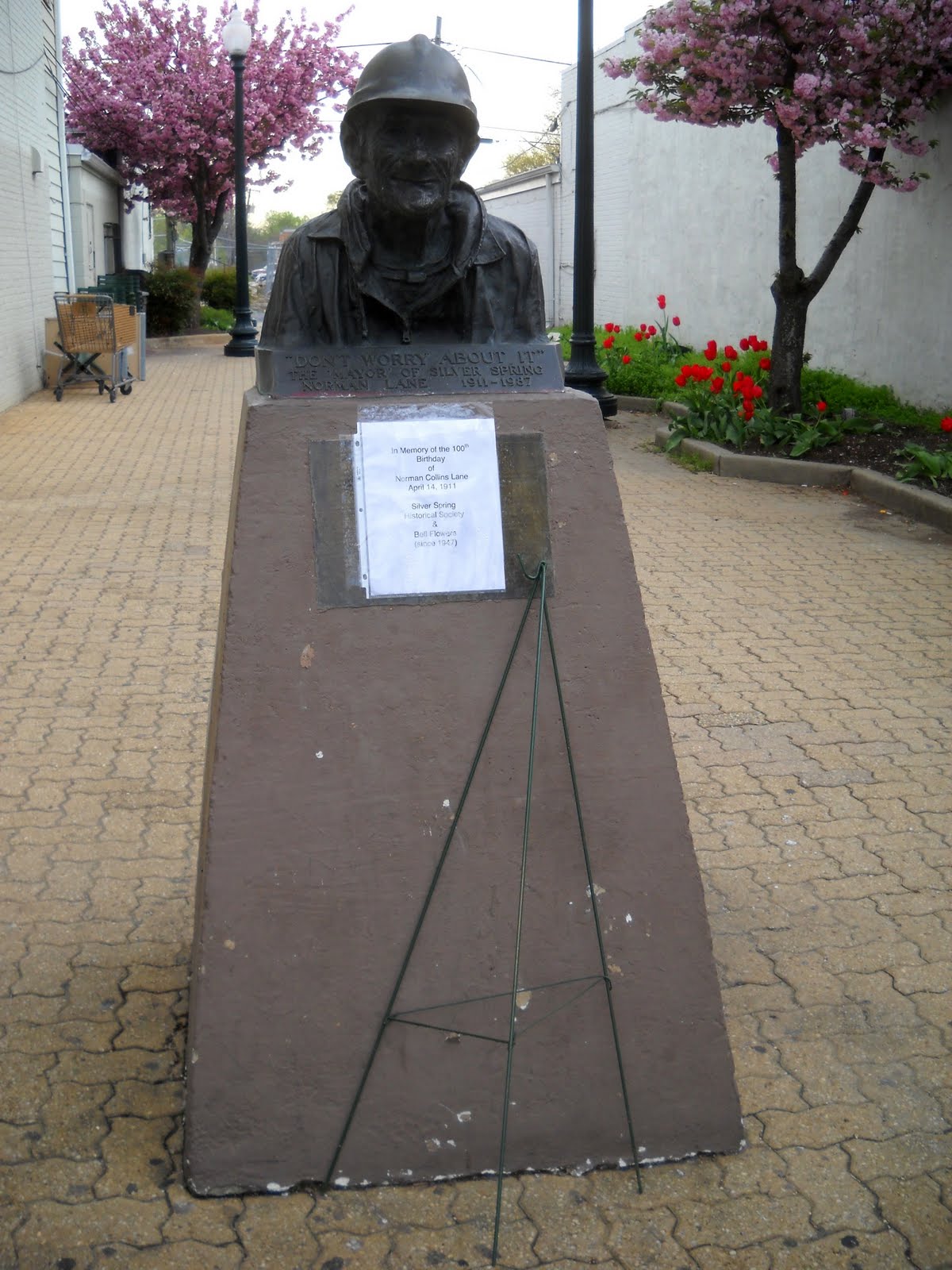
On April 14th the Silver Spring Historical Society commemorated the 100th anniversary of the birth of Norman Lane, the "Mayor" of Silver Spring.  A brief ceremony was held on Georgia Avenue at the statue depicting Norman that was created by artist Fred Folsom in 1991.  The event included the placing of a beautiful floral wreath generously donated by Bell Flowers.


During my remarks to the five people who took the time to remember Norman, I mentioned that I expected the wreath to be stolen before the day was over.  Well, I was a bit too pessimistic.  It lasted four days before it was ripped off.  Whoever stole it, sometime between Sunday afternoon and this morning, couldn't be bothered with the metal stand that the wreath was attached to and left it behind.


This event sadly reminds me of a recent exchange I had with an individual who thought "someone" should find a copy of the Grecian nymph statue that originally graced (nearly a century ago) the stone grotto of the Silver Spring and install it.  I told this person that such a statue wouldn't stand a chance of surviving because vandals would either destroy it or steal it outright.  This person was incredulous that anyone would do such a thing.

Ah, the joy of ignorance.

The little benevolent piece left inside of me should say, "If this person needed the flowers so badly, then they should have and enjoy them."  But it just can't.  For too long disrespect has been shown to Silver Spring's heritage and this theft is simply the latest example.

Thursday, April 14, 2011

Happy 100th Birthday Norman!

Half a dozen folks gathered this morning at Georgia Avenue's Mayor's Promenade to honor the 100th birthday of Norman Lane.  Placed before artist Fred Folsom's 1991 portrait bronze statue of Norman was a beautiful floral wreath donated by Bell Flowers (thanks Chad Mangum!).

(Left to right) Chad Mangum, Jerry A. McCoy, Charles Atwell,
Richard Jaeggi, Chris Matthews, unidentified.  Top & bottom photos by George French.


The quick 15 minute event began and ended on a note that Norman would have especially appreciated.  A homeless man approach one of the free newspaper boxes positioned directly opposite the statue.  He opened the box and started rooting through the newspapers and, one by one, pulled out four cans of malt liquor.

After the formal portion of the ceremony was over a few of us were talking when a different homeless man came around the corner singing out loud and barged right into the middle of our group.  He asked for money for "coffee."  In return he was asked, "Do you know where you are going to go to buy it?"  He responded, "No."  It was suggested to him that Kefa Cafe would be a good place to go!  I don't know if money was proffered for at that point I needed to leave to go to work.

This fall will be the 20th anniversary of the statue's dedication.  Perhaps another event can be held to commemorate one of the best examples of public art in Montgomery County.


Photo by Jerry A. McCoy